
How to Calculate Your True Return on Investment Before Buying
By Calculatorbudy Team | Last Updated: April 16, 2026
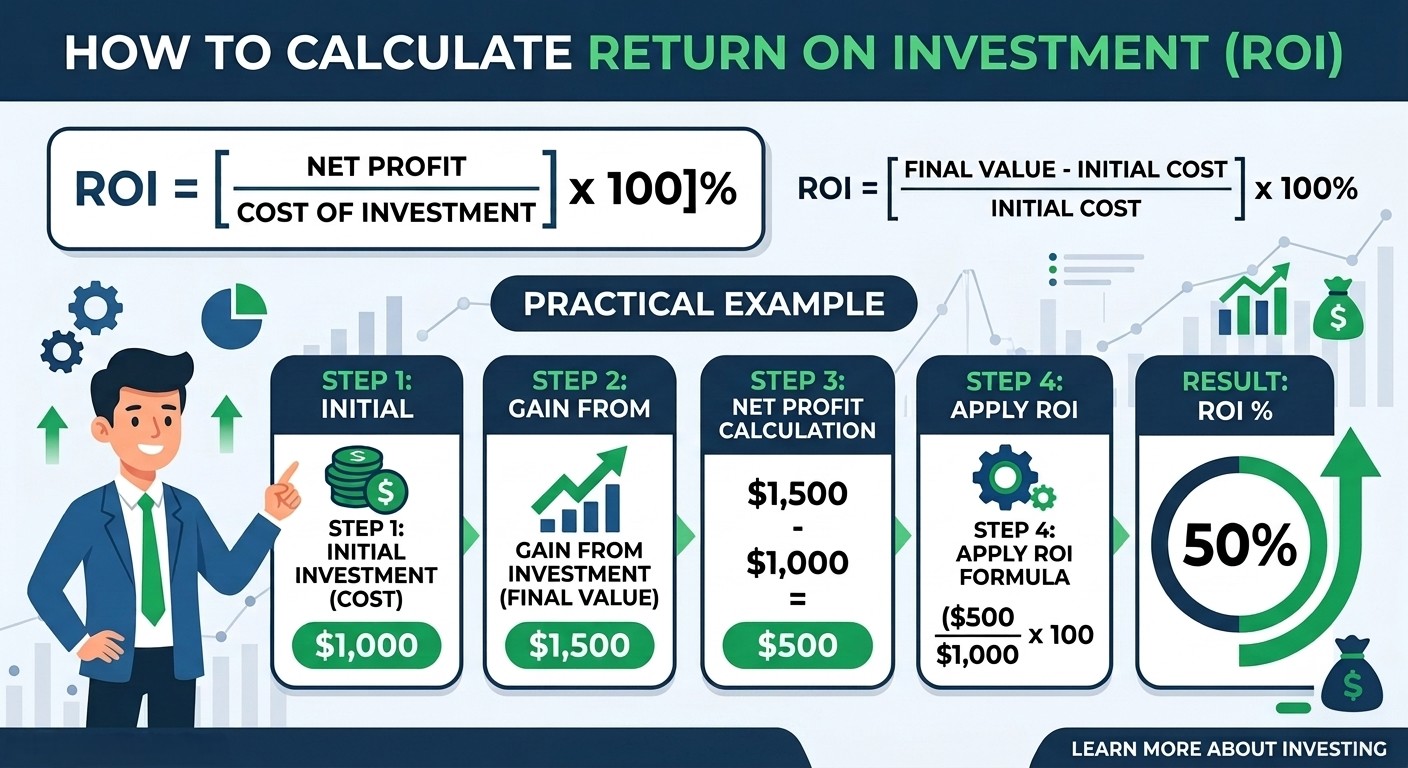
Before making any major investment decision, mastering your ROI calculation is essential. Making a big purchase often feels like a guessing game, whether you are buying a piece of equipment for your business, upgrading your software, or investing in real estate. Many buyers focus only on the initial price and obvious profit, but uncovering your actual Return on Investment (ROI) means revealing the hidden costs that directly impact your final financial return.
Quick insight: Most people calculate ROI wrong and lose money without realizing it.
According to financial experts, ROI is one of the most widely used investment metrics.
- Always include hidden costs in ROI
- Use ROI formula correctly
- Calculate payback period before investing
- Remember to factor in taxes, interest, and maintenance
What is True ROI?
Standard ROI just looks at the purchase price compared to the profit it generates, which you can easily evaluate using a profit margin calculator. True ROI goes deeper. It accounts for all the hidden costs associated with the purchase. These include maintenance, training time, subscriptions, and the opportunity cost of tying up your funds (which you can project using a compound interest calculator).
One critical factor often ignored is the time value of money, which reduces the real value of future returns. If you are financing the equipment, you must also factor in your interest rates and monthly installments, which you can easily map out using a Business Loan Calculator or an EMI calculator. To put it simply, basic calculations give you a snapshot, while true ROI gives you the entire financial picture. Understanding this difference is what separates average buyers from smart investors.
The Basic Formula
The math is straightforward. Calculations are based on standard formulas. You take the net profit of the investment, divide it by the total cost, and multiply by 100 to get a percentage.
Breaking Down the Real Costs
To get an accurate picture, you need to factor in everything before doing the math. Failing to account for any of these variables will inflate your projected return.
Upfront Price
This is the initial sticker price of the item. It includes shipping, handling, installation fees, and any immediate taxes applied at the point of sale.
Operational Costs
Factor in monthly fees, power consumption, or required ongoing supplies. For software, this means recurring subscription fees. For machinery, this includes the cost of electricity or fuel to keep it running.
Time Investment
Include the hours you spend setting the product up or learning how to use it. Time is money. If you or your team have to spend 40 hours learning a new system, calculate the hourly wage of those employees and add it to your total cost.
Asset Life and Depreciation
Calculate how quickly the item loses value. You can estimate this drop over time using a Depreciation Calculator. An item that breaks after two years will require replacement much sooner than one built to last a decade.
Taxes and Financing Fees
If you take out a loan to make a purchase, the interest you pay reduces your total return. Additionally, taxes on the asset or the new revenue it helps generate will take a bite out of your net profit.
How to Improve Your Expected ROI
If your initial calculation looks lower than you hoped, do not panic. You can often improve your projected return before you even pull the trigger on a purchase. Here are a few ways to shift the math in your favor:
- Negotiate the upfront cost: A lower starting price immediately boosts your final percentage. Always ask for bulk discounts or introductory rates.
- Extend the asset's lifespan: Committing to regular maintenance can add years to a machine or property's life, spreading the initial cost over a longer, more profitable period.
- Automate processes: Reduce the ongoing time investment required to operate the new asset. Less labor means lower operational costs.
Common ROI Mistakes to Avoid
Even with the right formula, it is surprisingly easy to miscalculate your return if you are not careful. Here are the most common pitfalls buyers face when planning an investment:
- Ignoring maintenance costs: Many buyers only look at the upfront price tag. However, physical assets like machinery or property require ongoing repairs, and software often requires costly updates or ongoing IT support. If you leave these out, your projected ROI will be artificially high.
- Overestimating revenue: It is natural to be optimistic about a new investment, but projecting best-case scenario sales or massive immediate savings is a risky move. Always use conservative estimates for your expected total return to ensure your investment is truly viable even in a slow market.
- Not considering the time value of money: A return generated tomorrow is worth more than a return generated five years from now because of inflation and lost investment opportunities. If your payback period spans several years, you need to factor in how the value of money changes over time to get an accurate financial picture.
Tip: Use our calculator to avoid manual errors.
A Real-World Example
Let us say you buy a new commercial oven for your bakery. The upfront cost is 5,000. Over a year, it helps you sell 10,000 worth of extra bread. However, it costs 1,000 in electricity and maintenance. Note: Results shown are for estimation purposes. Currency can be interpreted based on your region.
| Component | Amount |
|---|---|
| Total Return | 10,000 |
| Total Cost | 6,000 |
| Net Profit | 4,000 |
| ROI | 66.6% |
By running these numbers, you can clearly see a solid 66.6% return in the first year. This means for every dollar spent on the oven, the bakery got its dollar back plus an additional 66 cents in profit.
Why ROI Should Not Be Your Only Metric
While calculating your return is critical, it should not be the only factor in your decision. ROI is a purely financial metric. It does not measure intangibles like employee morale, brand reputation, or customer satisfaction. For example, upgrading the lighting and chairs in your office might have a low direct financial return, but it could significantly improve your team's productivity and well-being. Always balance the hard financial numbers with your broader, long-term strategic goals.
Why This Guide Exists
We created this guide because many people oversimplify their purchasing decisions and end up losing money on hidden expenses. By understanding how to calculate true ROI and knowing your exact payback period, you can make smarter financial choices. Whether you are scaling a business or managing personal finances, doing the math upfront prevents headaches later. Please note that when using any tools on our site to calculate these figures, no personal data is stored.
Try our free ROI calculator online to instantly calculate your returns.
Frequently Asked Questions
What is a good ROI percentage?
A good ROI depends entirely on the industry and the risk profile of the investment. Generally, a return of 10% to 15% is considered solid for stock market investments, while business equipment investments often aim for 20% or higher to justify the initial capital outlay.
Does ROI include hidden costs?
True ROI must include all hidden costs like maintenance, setup time, interest on loans, and ongoing operational expenses. Simple ROI often ignores these, leading to inaccurate financial projections.
What is annualized ROI?
Annualized ROI breaks down your total return into a yearly percentage rate. This is very useful for comparing two different investments that you plan to hold for different lengths of time.
How do you calculate ROI on software?
Calculating software ROI requires factoring in the upfront cost or subscription fee, the time spent training employees to use the new system, and the specific dollar value of the working hours saved by using the software.